
What Makes a Product Page Convert: From Visitor to Buyer
What Makes a Product Page Convert: From Visitor to Buyer
A great product page isn’t about showing your product—it’s about selling it. Yet most ecommerce brands treat their product pages like an online brochure: pretty photos, a few lines of copy, and a checkout button. That’s not enough. Not when attention is limited and competition is everywhere.
Your product page is one of the most important pieces of real estate in your entire business. It’s where hesitation either disappears—or multiplies. And if it’s not built to convert, you’re leaving serious money on the table.
Here’s how to transform your product page from a scroll-past to a sale.
Start with a headline that makes a promise
The first few lines of your product description—or the heading near your product name—should clearly answer: What is this, and why should I want it now? It’s not enough to list the product name. That tells people what it is. But what does it do? Who’s it for? Why does it matter?
Instead of saying:
“Calm Sleep Gummies”
Try:
“Fall asleep faster, stay asleep longer—without next-day grogginess”
When the first thing people read is a benefit they care about, they keep scrolling.
Make your visuals work harder
Yes, product images should be clean and high quality. But they should also tell a story. Show the product from multiple angles. Use lifestyle images so people can imagine themselves using it. Include video, especially vertical video, to showcase texture, movement, or use.
Product in isolation? Good.
Product in someone’s hand? Better.
Product being used in a real moment? Best.
Also: always, always use zoomable images and mobile-friendly galleries. Small details matter.
Turn features into benefits—and make them scannable
A block of text that lists ingredients, specs, or features isn’t persuasive. You need to translate those features into human language. Tell people what those features do for them. Use short bullets, but expand with context when needed.
Instead of:
- 200mg of magnesium
- Vegan formula
- Includes l-theanine
Say:
- 200mg of magnesium to help your body unwind naturally
- 100% vegan formula, zero animal byproducts or fillers
- L-theanine to support focus without jitters
Help your customer imagine the result, not just the ingredient.
Social proof needs to feel real—not staged
Reviews aren’t optional anymore. They’re expected. But they can’t feel like fluff. You want authentic, specific, and recent testimonials. Include photos or videos from real customers if you can. Don’t hide negative reviews—address them honestly and transparently.
And if you’re early-stage and don’t have a ton of reviews yet? Start gathering UGC through post-purchase follow-ups and email prompts. Even one great quote can go a long way.
Also: place your best reviews above the fold, not buried at the bottom.
Build urgency—but make it honest
Urgency works—but fake urgency backfires. Use real constraints when they exist: limited drops, seasonal inventory, or shipping cutoffs.
For example:
“Order by Sunday for delivery before the holiday”
“Only 17 units left—next batch ships in 2 weeks”
These aren’t gimmicks. They’re incentives to act now.
Your CTA button should do one thing: sell the click
This is not the place for creativity. Stick to CTA buttons that are clear, action-oriented, and easy to find.
Good:
- Add to Cart
- Get Yours
- Try It Now
Test placement and color, but don’t bury your button or make people scroll forever to find it.
If your product page isn't converting, it's not because people don’t want what you’re selling—it’s because the page isn’t making it clear, urgent, and trustworthy enough to act. Fix that, and everything from your ads to your email flows will start working better.


How to Build a Memorable Brand With Google Ads
How to Build a Memorable Brand With Google Ads
Google Ads are usually seen as a tool for capturing demand, not creating it. Most brands use them to show up when someone’s already looking—“skincare for dry skin,” “best running shoes,” “fast protein snacks.” That’s powerful. But there’s more to it.
Used strategically, Google Ads can also build brand memory, shape how you’re perceived, and position your offer before your customer ever lands on your site. The search results page is the new storefront. And when your brand shows up there with clarity, consistency, and authority, you’re not just winning clicks—you’re winning mindshare.
Let’s look at how to use Google Ads to not just drive sales, but grow a brand people remember.
Start with your branded search terms
Branded search terms—like “[your brand name] skincare” or “[your brand name] reviews”—may seem redundant to bid on. After all, if someone’s searching your brand, won’t they find you anyway?
Not always. Competitors can bid on your name. Review sites can outrank your homepage. And if you don’t show up first, someone else controls the narrative.
Bidding on your branded terms is like owning your front door. You ensure that the first impression people get—whether they heard about you on TikTok or through word of mouth—is one you control. Your copy, your message, your voice.
And when that ad copy reinforces what makes your brand different, it becomes more than a navigation tool—it becomes a reinforcement loop.
Go beyond direct response: build intent over time
Most marketers only target high-intent keywords. That makes sense if you’re looking for conversions now. But if you want long-term brand growth, you need to show up before your customer is ready to buy.
Let’s say you sell a clean energy drink. Don’t just bid on “buy clean energy drink.” Build campaigns around:
-
“Why am I always tired in the afternoon?”
-
“Is caffeine bad for anxiety?”
-
“Healthy alternatives to Red Bull”
-
“How to boost energy without sugar”
These keywords are where intent begins. When your brand is present at this stage, you earn trust before your competitors even enter the picture.
You’re not just selling a product—you’re helping solve a problem. That’s brand equity in motion.
Use your copy to deliver brand feeling, not just info
Most Google Ads read like plain labels. “Fast shipping. Quality guaranteed. Buy now.” That’s fine—but forgettable.
Your copy should echo the voice of your brand, even in 90 characters. Use your headline and description to communicate something emotional, personal, or bold.
Instead of:
“Clean skincare. Free shipping. Order now.”
Try:
“Finally—skincare that respects your skin (and your standards).”
“Thousands of people made the switch. Here’s why.”
This is your brand’s chance to speak in its own tone—even in a crowded auction.
Pair your search ads with smart landing pages
A strong Google Ad only works if the destination matches the expectation. If your ad copy promises relief from bloating, but your landing page leads with ingredients and product features, you’re creating dissonance.
Make sure your search ads are paired with intent-specific landing pages that speak directly to the searcher’s question, emotion, or motivation.
Someone searching “best vegan protein powder” isn’t just looking for a product—they’re looking for reasons to believe. Show social proof. Answer objections. Prove the difference. Do it fast, above the fold.
Great Google Ads feel like a natural step toward something useful—not a detour into generic marketing. It doesn't have to feel cold or transactional. With the right strategy, they can be one of your most powerful brand-building tools. Show up early. Speak with clarity. Reinforce what makes you different. Do that enough times, and your audience won’t just click—they’ll remember you.
How to Launch Meta Ads with a Small Budget (That Still Work)
How to Launch Meta Ads with a Small Budget (That Still Work)
Meta ads are one of the fastest ways to drive traffic and sales—but they’re also one of the fastest ways to lose money if you don’t know what you’re doing. And when you’re running on a small budget, every dollar matters. The good news? You don’t need to spend $10K a month to get results. You need a smart structure, sharp creative, and tight targeting. Meta is still one of the most powerful platforms for performance marketing—it just punishes lazy execution. This guide shows how to run high-performing Meta ads with a lean budget, without wasting time or cash.
Why most low-budget ad campaigns fail
The biggest mistake small brands make is trying to copy what big brands do—with none of the resources. They run broad targeting, try to scale too fast, or focus on vanity metrics like reach instead of conversions.
Even worse, they launch with a single creative and wait for magic. A small budget isn’t a disadvantage. It’s a constraint that forces precision. You can’t afford waste—so every move has to work harder.
Set your daily budget realistically
Start small—but not too small. A campaign with $1–$2/day won’t give you useful data. Aim for $10–$30/day for your core test campaign. That’s enough to gather learnings quickly without burning cash. Start with a 7-day test window. That gives the algorithm enough time to optimize. You’re not trying to scale yet—you’re trying to learn.
Use the Conversion objective from day one
Don’t waste time on Traffic or Engagement objectives “to warm things up.” Meta’s algorithm is smart enough now to find conversions—even with small data sets.
Choose Sales as your campaign objective and optimize for the event closest to your goal (e.g., “Purchase” or “Add to Cart”).
This forces your ad to be judged by real outcomes, not clicks or likes.
Limit your ad set variables
The more variables you test, the more budget you need. So keep it simple:
- One audience per ad set
- One placement (start with Advantage+ placements)
- One conversion goal
- 2–3 creatives per ad set max
If you run 10 audiences and 6 creatives at once, your $30/day gets sliced into tiny, useless pieces.
Start with your warmest audience (e.g., website visitors, Instagram engagers, email list), then test one cold interest-based audience that closely matches your ideal buyer.
Build native-looking creative
Small budgets can’t afford bad hooks. If your ad doesn’t stop the scroll in 1–2 seconds, you’re done.
You don’t need fancy design—you need relevance.
Start with these formats:
- UGC-style video: A customer or team member explaining the product in selfie format
- Problem/solution format: “I couldn’t sleep through the night... until this”
- Testimonial clip: Real quote or video from a user
- Before/after visuals: Show the transformation your product delivers
- Face-to-camera: Founders work great here. Speak directly to the customer.
Design your creative for mobile first. Add subtitles. Use bold, simple captions. Get to the point.
Watch the right metrics
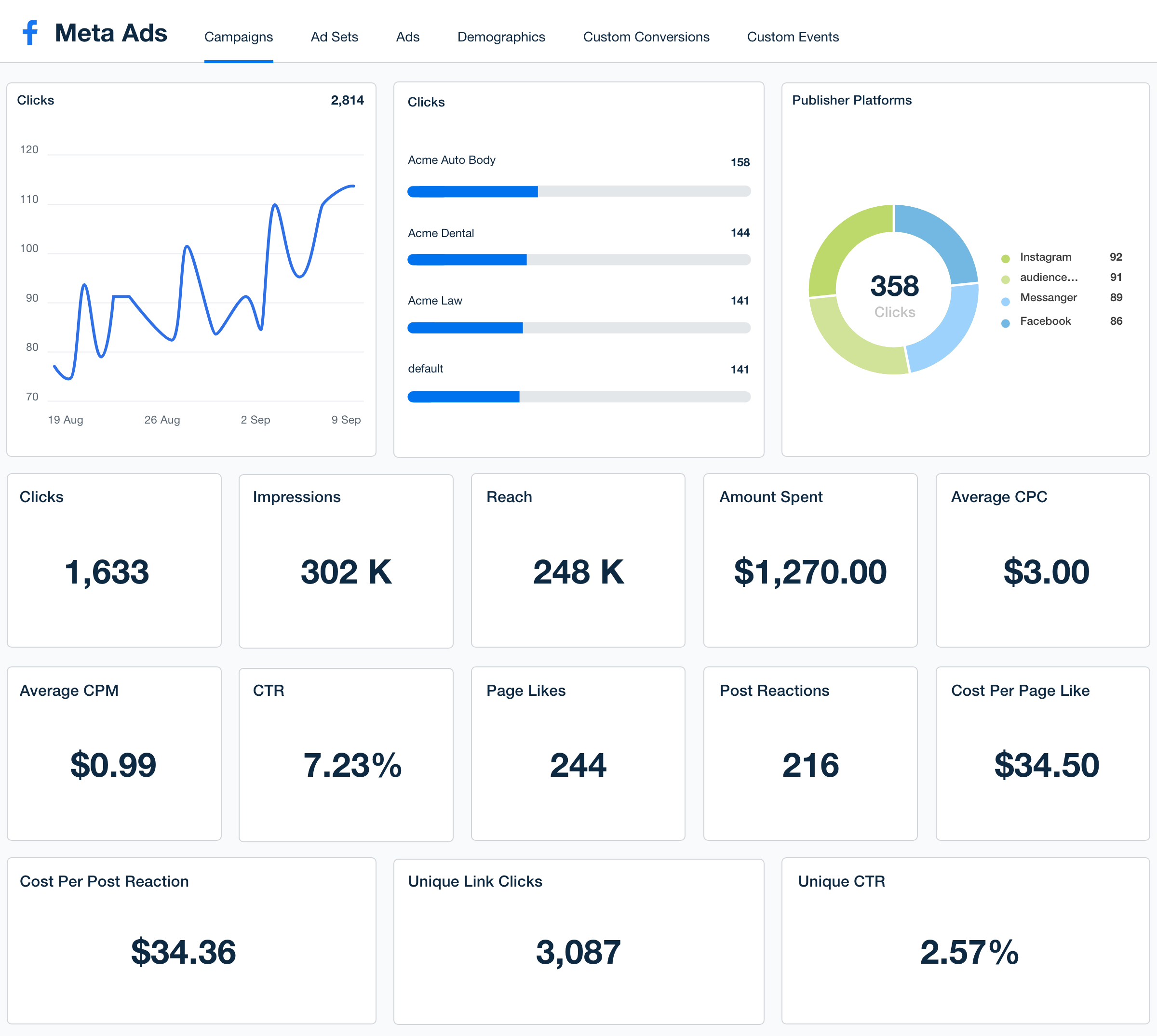
Forget likes and views. These are the metrics that matter in a small-budget Meta campaign:
- CTR (link click-through rate): Tells you if the creative is compelling
- CPC (cost per click): Lower means better engagement
- CPM (cost per 1,000 impressions): Tells you what the audience is costing
- Conversion rate (on-site): Confirms if the landing page is working
- ROAS (return on ad spend): The only real performance metric
If your CTR is under 1%, your creative needs work. If your conversion rate is under 1%, your offer or landing page needs help.
Use those signals to adjust before throwing more money in.
Use retargeting the right way
One of the biggest advantages of Meta ads is how easily you can create custom audiences.
With a small budget, build two basic retargeting buckets:
- Site visitors or video viewers (past 7–14 days)
- Add to cart but didn’t buy (past 3–7 days)
Run simple, clean ads to these groups with urgency, proof, or incentives. Keep the message direct: “Still thinking about it?” or “You left this behind.”
Even a $5/day retargeting campaign can bring strong returns if the traffic is warm.
You don’t need a big budget—you need tight execution
Meta ads don’t reward brands with deep pockets. They reward brands that know how to deliver a relevant message, to the right person, at the right time.
With $20/day and the right setup, you can test offers, validate messaging, build warm audiences, and generate consistent sales. You don’t need to go viral. You need to be clear, consistent, and conversion-focused.
Start small. Launch lean. Optimize fast.

Performance Marketing Explained Like You’re 5
Performance Marketing Explained Like You’re 5
Performance marketing sounds intimidating. ROAS, CAC, LTV, AOV—it feels like alphabet soup. But here’s the truth: performance marketing is simply marketing that’s built to be measured. You spend money, track what happens, and keep spending if it works.
It’s not just for big brands with analytics teams and $100K ad budgets. It’s how any founder, marketer, or solo creator can grow with limited resources—as long as they understand the basics.
Let’s break it down in plain English, no jargon needed.
You spend money to make money—but only if the numbers work
Imagine you’re selling cookies. You pay $5 to run an Instagram ad. If someone clicks and buys a $20 box of cookies, you made $15 (gross). That’s performance marketing.
Now, imagine that out of 100 people who see the ad, only 3 buy. That’s a 3% conversion rate.
If you made $60 in sales and spent $30 to get it, your ROAS (return on ad spend) is 2.0. For every dollar you spent, you made two. Not bad.
This is the game. You spend to get traffic. Then you measure what percentage of that traffic becomes customers—and whether the math makes sense to keep going.
Every dollar should have a job
Performance marketing isn’t about boosting posts and hoping for the best. It’s about assigning roles.
- Meta Ads (Facebook/Instagram): Grab attention fast and drive action
- Google Search Ads: Capture people already searching for a solution
- TikTok Ads: Build buzz and visibility, especially for DTC brands
- Retargeting: Bring back people who showed interest but didn’t convert
Each piece of the funnel has a role. Your job is to guide people from cold to warm to ready.
The key metrics (in human language)
- ROAS: Return on ad spend. If you spend $1 and make $3, that’s a 3.0 ROAS
- CAC: Customer acquisition cost. How much it costs to get one buyer
- LTV: Lifetime value. How much a customer is worth over time
- AOV: Average order value. How much people spend each time they buy
- CTR: Click-through rate. Percentage of people who click your ad
- CVR: Conversion rate. Percentage of site visitors who buy
Don’t get overwhelmed by the numbers. Focus on one thing first: profitability. Are you spending less than you’re making?
Performance doesn’t mean ignoring brand
One mistake brands make is thinking that performance marketing and brand marketing are opposites. They’re not.
Your best-performing ads are often the ones that feel on-brand, human, and emotionally relevant. Performance just means those ads are built with a goal—clicks, leads, or sales—and you’re tracking how well they perform.
Brand without performance is awareness with no action. Performance without brand is sales with no soul. You need both.
You don’t need a marketing degree to run performance campaigns. Not only that, but you just need to know your numbers, trust your message, and be willing to test. Keep it simple. Keep it measurable. And remember—every dollar should be able to explain what it did for your business.