

Performance vs. Brand Marketing: Which One Does Your Business Actually Need?
Performance vs. Brand Marketing: Which One Does Your Business Actually Need?
It’s the debate that haunts every founder, CMO, and marketer with a limited budget:
Should we focus on performance—ads that convert?
Or should we invest in brand—content that builds long-term loyalty?
The truth is, you need both. But depending on your stage, product, and goals, one may need to lead.
Understanding the difference—and how to balance them—is what separates brands that flash and fade from the ones that scale with consistency.
Let’s break it down.
What performance marketing actually does
Performance marketing is built to drive a specific action, usually in a short timeframe. Think Meta ads, Google search campaigns, retargeting, conversion-focused emails—anything that’s trackable and tied directly to ROI.
It’s fast. It’s measurable. It’s scalable.
This is where you test offers, learn what messaging converts, and drive immediate results. If you’re launching a product, trying to grow revenue this quarter, or prove traction to investors, performance is your workhorse.
But there’s a catch: performance alone can’t build belief. It can bring people in—but it can’t always make them stay.
What brand marketing does differently
Brand marketing plays the long game. It builds emotional connection, story, and memory. It’s what makes someone choose your product over a cheaper one. It’s why they wear your hoodie, not just buy your product.
Brand marketing shows up in:
- Founder stories and origin content
- Behind-the-scenes posts
- UGC and community features
- Educational series
- Thoughtful packaging and tone of voice
- Campaigns that spark emotion, not just clicks
Done right, brand makes your performance marketing cheaper. Because people already know who you are when they see the ad.
The real question: what’s your constraint?
If your business needs cash flow right now, go heavier on performance. But if your ROAS is dropping, CAC is rising, and retention is flat—chances are you’ve leaned too far in and neglected brand.
Here’s a simple matrix:
| Your Problem | What You Likely Need More Of |
|---|---|
| Low sales | Performance |
| High churn | Brand |
| Low site traffic | Performance |
| Weak retention | Brand |
| Great ROAS, no followers | Brand |
| High followers, low sales | Performance |
Balance is the goal. But balance doesn’t mean equal. It means strategic allocation.
What it looks like to run both at once
Let’s say you’re launching a new CPG product. Here’s how you might split your energy:
-
Performance side:
-
Launch ads with strong hooks + clear CTA
-
Retargeting flows via email/SMS
-
Offer-based landing pages
-
-
Brand side:
-
Document the launch story on social
-
Share behind-the-scenes of product development
-
Collaborate with micro-creators on UGC
-
Invest in storytelling video assets
-
Each supports the other. The performance side drives sales. The brand side builds affinity and lowers CAC over time.
What founders get wrong about brand vs. performance
The biggest misconception is that brand is a luxury and performance is a necessity. That’s backwards.
Brand is the reason people choose you in the first place—and the reason they come back. If you build performance without brand, you’re renting growth. As soon as you stop spending, everything dries up.
On the flip side, if you go full brand with no performance, you risk beautiful content with no cash flow.
This isn’t either/or. It’s both, in the right ratio.
Every business hits a point where pure performance stops working. That’s your cue to build brand. And every brand that only vibes eventually needs performance to scale. If you want to grow sustainably, the question isn’t “Which one should we do?”
It’s: What’s the smartest way to blend both—right now?

How to Launch Meta Ads with a Small Budget (That Still Work)
How to Launch Meta Ads with a Small Budget (That Still Work)
Meta ads are one of the fastest ways to drive traffic and sales—but they’re also one of the fastest ways to lose money if you don’t know what you’re doing. And when you’re running on a small budget, every dollar matters. The good news? You don’t need to spend $10K a month to get results. You need a smart structure, sharp creative, and tight targeting. Meta is still one of the most powerful platforms for performance marketing—it just punishes lazy execution. This guide shows how to run high-performing Meta ads with a lean budget, without wasting time or cash.
Why most low-budget ad campaigns fail
The biggest mistake small brands make is trying to copy what big brands do—with none of the resources. They run broad targeting, try to scale too fast, or focus on vanity metrics like reach instead of conversions.
Even worse, they launch with a single creative and wait for magic. A small budget isn’t a disadvantage. It’s a constraint that forces precision. You can’t afford waste—so every move has to work harder.
Set your daily budget realistically
Start small—but not too small. A campaign with $1–$2/day won’t give you useful data. Aim for $10–$30/day for your core test campaign. That’s enough to gather learnings quickly without burning cash. Start with a 7-day test window. That gives the algorithm enough time to optimize. You’re not trying to scale yet—you’re trying to learn.
Use the Conversion objective from day one
Don’t waste time on Traffic or Engagement objectives “to warm things up.” Meta’s algorithm is smart enough now to find conversions—even with small data sets.
Choose Sales as your campaign objective and optimize for the event closest to your goal (e.g., “Purchase” or “Add to Cart”).
This forces your ad to be judged by real outcomes, not clicks or likes.
Limit your ad set variables
The more variables you test, the more budget you need. So keep it simple:
- One audience per ad set
- One placement (start with Advantage+ placements)
- One conversion goal
- 2–3 creatives per ad set max
If you run 10 audiences and 6 creatives at once, your $30/day gets sliced into tiny, useless pieces.
Start with your warmest audience (e.g., website visitors, Instagram engagers, email list), then test one cold interest-based audience that closely matches your ideal buyer.
Build native-looking creative
Small budgets can’t afford bad hooks. If your ad doesn’t stop the scroll in 1–2 seconds, you’re done.
You don’t need fancy design—you need relevance.
Start with these formats:
- UGC-style video: A customer or team member explaining the product in selfie format
- Problem/solution format: “I couldn’t sleep through the night... until this”
- Testimonial clip: Real quote or video from a user
- Before/after visuals: Show the transformation your product delivers
- Face-to-camera: Founders work great here. Speak directly to the customer.
Design your creative for mobile first. Add subtitles. Use bold, simple captions. Get to the point.
Watch the right metrics
Forget likes and views. These are the metrics that matter in a small-budget Meta campaign:
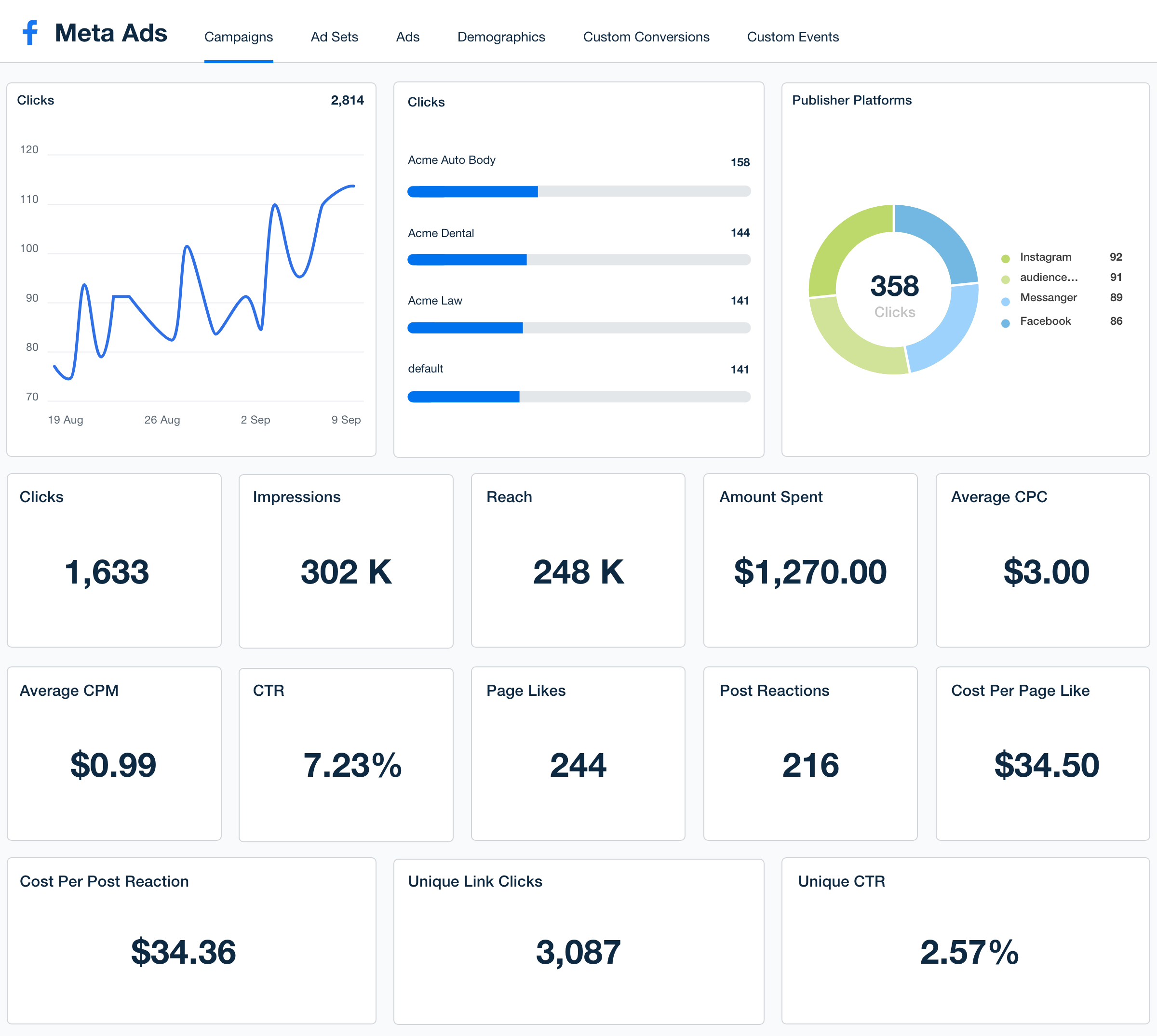
- CTR (link click-through rate): Tells you if the creative is compelling
- CPC (cost per click): Lower means better engagement
- CPM (cost per 1,000 impressions): Tells you what the audience is costing
- Conversion rate (on-site): Confirms if the landing page is working
- ROAS (return on ad spend): The only real performance metric
If your CTR is under 1%, your creative needs work. If your conversion rate is under 1%, your offer or landing page needs help.
Use those signals to adjust before throwing more money in.
Use retargeting the right way
One of the biggest advantages of Meta ads is how easily you can create custom audiences.
With a small budget, build two basic retargeting buckets:
- Site visitors or video viewers (past 7–14 days)
- Add to cart but didn’t buy (past 3–7 days)
Run simple, clean ads to these groups with urgency, proof, or incentives. Keep the message direct: “Still thinking about it?” or “You left this behind.”
Even a $5/day retargeting campaign can bring strong returns if the traffic is warm.
You don’t need a big budget—you need tight execution
Meta ads don’t reward brands with deep pockets. They reward brands that know how to deliver a relevant message, to the right person, at the right time.
With $20/day and the right setup, you can test offers, validate messaging, build warm audiences, and generate consistent sales. You don’t need to go viral. You need to be clear, consistent, and conversion-focused.
Start small. Launch lean. Optimize fast.